Learn more
How letterpress printing with lead type works
Printing with lead type means setting the text letter by letter with loose metal pieces, locking them into a forme, inking them and pressing paper against them on a press. It is the technique invented by Gutenberg around 1450 and the one we use in our workshop.
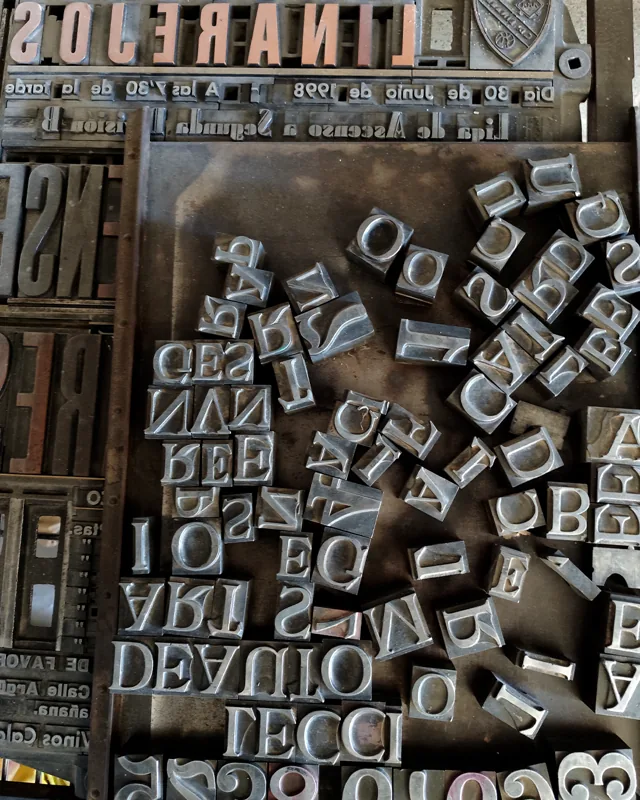
The type case and the composing stick
Type is stored in wooden cases divided into compartments, one per character. The compositor picks up the letters one by one and places them in the composing stick, a metal rule set to the width of the line. The letters sit reversed and upside down, so that they print the right way round.
Between words go spaces, lower pieces that take no ink. When the line is complete it is justified, that is, adjusted with thin spaces until it fits the measure exactly.
The galley and the forme
The set lines are transferred to the galley, a tray where the page takes shape. Between lines go strips of lead, the leading, which gives the text its air. When the page is complete it is tied with string and moved to the chase, an iron frame where it is locked up with quoins. The whole, immobilised, is the forme.
Illustrations are fitted into the forme like any other piece of type: a woodcut or a mounted plate brought up to type height, which is always the same, 23.56 millimetres.
Inking and printing
Ink is spread over the forme with a roller or, on the oldest presses, with leather ink balls. The paper, slightly dampened so that it takes the ink better, is laid on and the press squeezes it against the type. The pressure leaves a faint impression in the paper that you can feel with a fingertip and see against the light: it is the signature of letterpress.
After printing, the forme is broken up and every piece of type goes back to its compartment. That is why it is called movable type: the same letter serves to set a thousand different pages.